
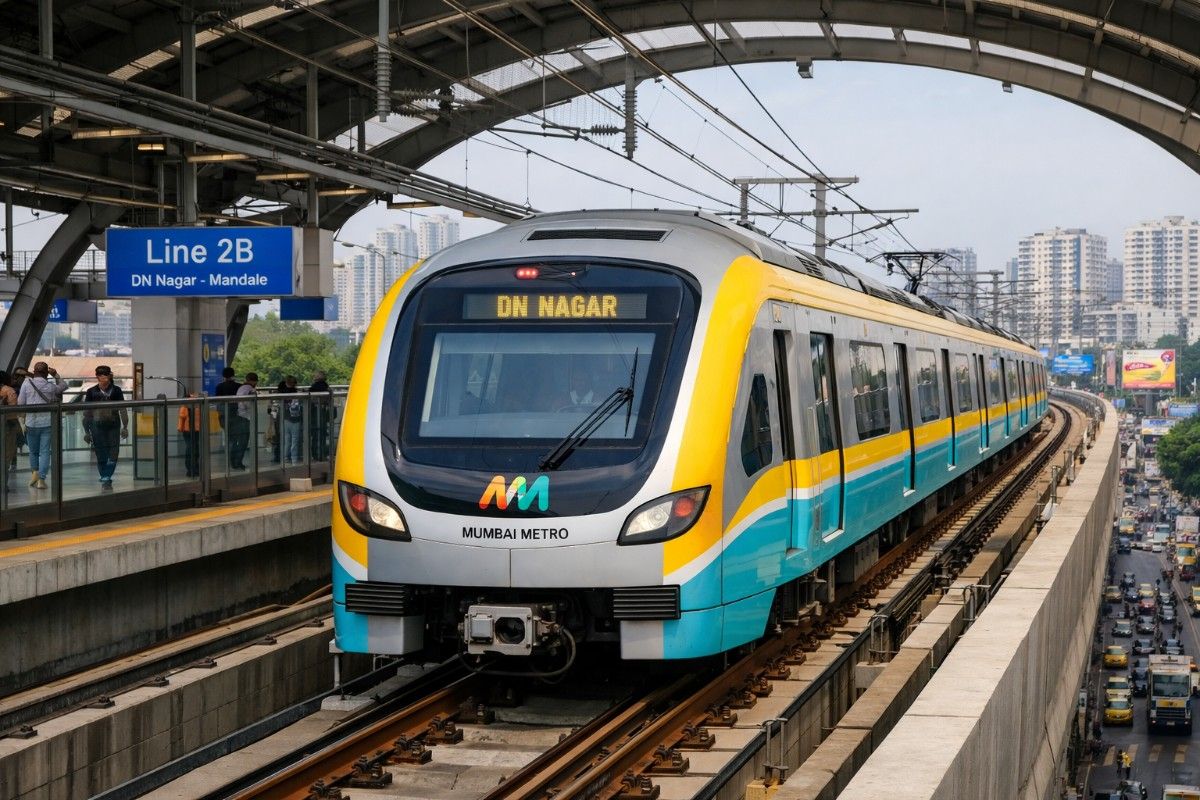
1) Metro Line 2B in one page (the hard facts)
What it is: Mumbai Metro Line 2B is an elevated corridor from D.N. Nagar to Mandale, designed to strengthen east–west connectivity across suburban Mumbai.
Length & stations: 23.643 km with 20 elevated stations.
Stations (west to east): ESIC Nagar, Prem Nagar, Indira Nagar, Nanavati Hospital, Khira Nagar, Saraswat Nagar, National College, Bandra Metro, Income Tax Office, ILFS, MTNL Metro, SG Barve Marg, Kurla (E), EEH, Chembur, Diamond Garden, Shivaji Chowk, BSNL Metro, Mankhurd, Mandale Metro.
Interchanges (key for value impact):
- D.N. Nagar (connects with Metro Line 1)
- Bandra (Suburban rail)
- ITO Junction (planned interchange with Metro Line 3)
- Kurla East (Suburban + Line 4 planned)
- Chembur (Monorail)
- Mankhurd (Suburban)
MMRDA’s stated travel-time impact: reduction of ~50% to 75% (depends on road conditions).
Recent status update on MMRDA page: As of 30.11.2025, major civil elements show very high completion percentages (pile caps, piers, pier caps/portal beams, girder works, depot).
2) Why this can lift Andheri West prices (the “mechanisms”)
A) Andheri West becomes a true multi-directional connector, not just a “Western line suburb”
Andheri West already has strong demand, but east–west travel is where pain (time + unpredictability) lives. A fast metro connection that links Andheri side to Bandra/Kurla/Chembur/Mankhurd nodes changes the “mental map” of commute choices. When commute friction drops, the radius of acceptable workplaces expands, and a well-located home gains more bidders.
Important nuance: The biggest value effect for Andheri West specifically typically arrives when:
- the full corridor to major job/rail nodes is operating reliably, and
- interchanges (Line 1, and later Line 3/4 linkages) create “network effects.”
B) Metro-driven demand is no longer theoretical in Mumbai
Operational lines are now showing heavy adoption:
- Metro Lines 2A & 7 have hit record ridership levels and service increases, reflecting sustained commuter shift.
This matters because buyers pay more for “proven convenience” than for “promised convenience.”
C) The “station premium” tends to concentrate around walkable catchments
In many cities, value uplift clusters within a walkable/short-access radius around stations, then fades with distance. You don’t need a blanket Andheri West-wide price jump for the thesis to be true: even a micro-market lift around the most convenient access points can pull up comparables over time.
In Andheri West’s case, the likely beneficiaries are:
- pockets with clean access to D.N. Nagar and the Line 2B approach corridor (and good last-mile),
- buildings that offer quiet + connectivity (because elevated metros can introduce noise on certain frontages).
D) Line 2B stitches together multiple high-demand ecosystems
Look at the station list and interchanges: Bandra (suburban), Kurla (suburban, future network), Chembur (monorail), plus the wider BKC influence zone.
As these nodes integrate, Andheri West becomes more attractive to:
- senior professionals with multi-node work routines (meetings across BKC–Andheri–Chembur),
- tenants seeking predictable travel times (which supports rents, which supports capital values).
3) What research says (and why you should be cautious with “guaranteed appreciation”)
Real estate uplift from metros is common, but not automatic.
- A Mumbai-focused study on the VAG corridor (Line 1) reports an upward movement in prices/rents/transactions and travel-behavior changes (survey-based).
- But another Mumbai study (EPW paper using broader zone-level data and “upcoming metro” variables) found the upcoming metro effect on residential prices not statistically significant in their model, and warns about market distortions and data limitations.
Takeaway: Expect a probability-weighted uplift, not a guarantee. The uplift is strongest when:
- operations start and stabilize,
- interchange connectivity actually works end-to-end, and
- last-mile access is solved (walkability, feeder, parking, etc.).
Looking at Andheri West? Get our shortlist on WhatsApp
4) Andheri West: where the price pressure could come from (practical market logic)
Demand-side push
- More buyers/tenants value “20–40 minute predictable commutes” over “45–90 minute roulette.”
- Investors track rental resilience; improved connectivity often widens tenant pools.
Supply-side constraint
Andheri West is already supply-constrained in many premium pockets (redevelopment cycles, limited new large land parcels). When demand rises faster than livable supply, prices tend to firm up.
“Stage-of-network” effect
You often see two waves:
- Expectation premium (pre-operations): selective and story-driven.
- Proof premium (post-operations): broader, lender-friendly, comp-based.
Projects across Andheri West
Versova: Sea Bliss (ready), Lotus Amalfi, Lotus Portofino, Lotus Celestia, Godrej Skyshore, Viceroy Visava, Lodha Cullinan, Rustomjee Ocean Vista, Vann by Ajmera, Kolte Patil Serenova, Spenta Anthea, Westwood, Disha Elysium, Azure Residences, Platinum Vibe, MDM 9 Marina, Elysia, Vaibhav Vista, You & I
Four Bungalows: Poonam Polaris, MDM Maestro, Raiaskaran Parthenon (resale)
Lokhandwala: Oberoi Sky Heights, Kalpataru Vian, Purva Estrella, Bharat Alta Vista, DGS Sheetal Sky
New Link Road: Adani Linkbay Residences, Transcon Triumph Tower 4, Veena Imperia, Mayfair Aranya
Oshiwara: DLF The Westpark, Veena Insignia, Esquina Private Residences, Bharat Aura Vistas, Vista Residences, Multistar Autograph, Gurukrupa Ekam, Sunbeam Heights, Dream Aspire, DLH Leo (ready), The Park Residences (resale)
DN Nagar (Metro 2B interchange): Platinum Crest, Platinum Classic, Fame Garden
See all Andheri West projects, or WhatsApp us for current availability. Zero brokerage on new projects.